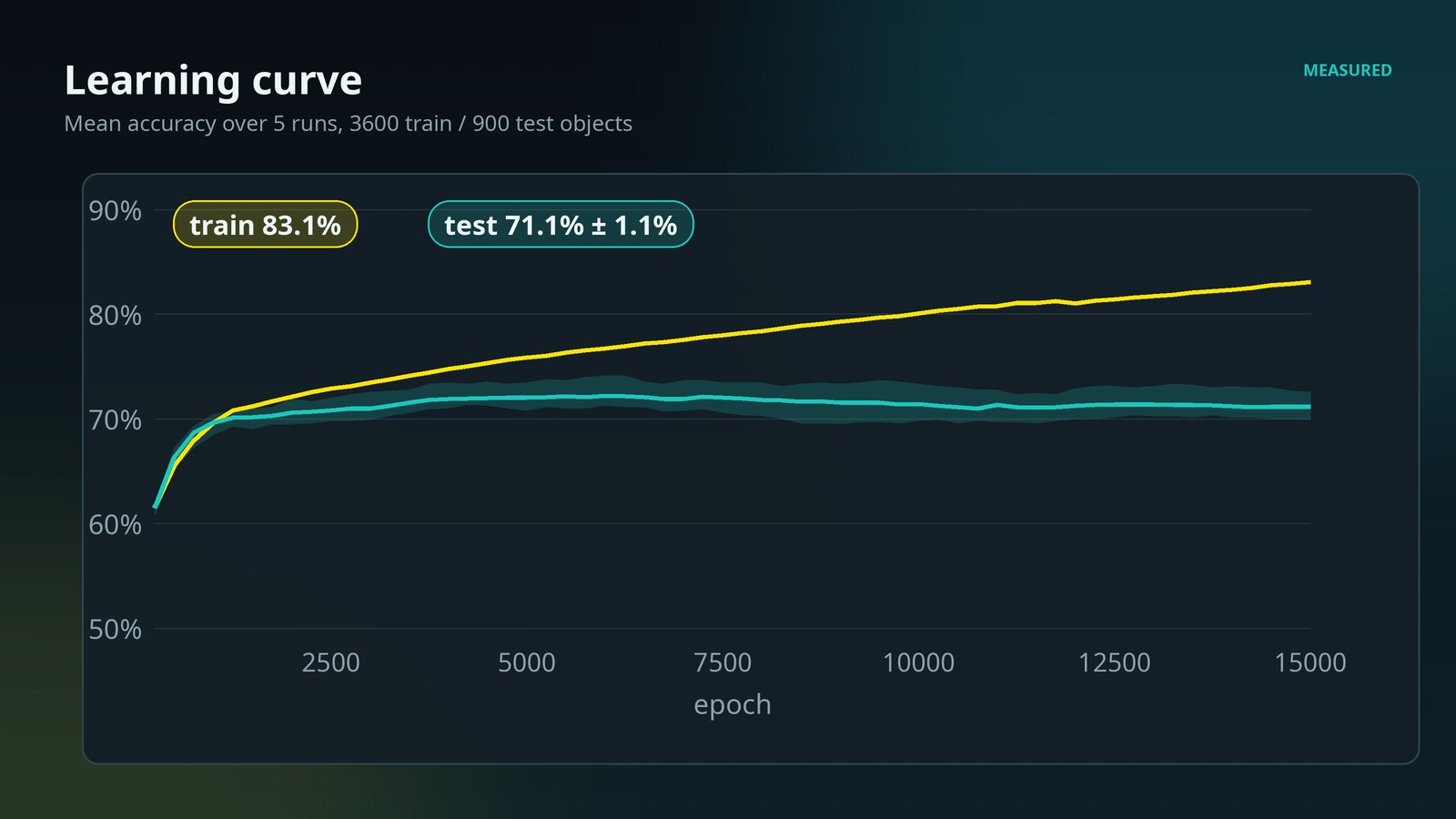
What 71% accuracy taught me: limits I found in my own pipeline
Training accuracy of 83% looked fine. The number that matters is the one on data the network never saw, and for my exoplanet classifier that was 71%. Getting an honest figure meant splitting the data, repeating the run with different seeds and reading the code again for things that could flatter the result.
What the code review found
- Zero means missing. The preprocessing replaces exact zeros with the feature median. For the false-positive flag count and the catalogue indicator this also overwrites real zeros, so those features carry less information than intended.
- Normalization leakage. The medians, means and standard deviations were computed on all 4500 objects before the split, so the test objects slightly influenced the constants.
- Sky position. Right ascension and declination are inputs. They can correlate with survey fields and discovery history rather than with physics.
- Balanced sample. The evaluation uses a class-balanced sample, not the natural class distribution of the archive.
- No baselines. I did not train logistic regression or gradient-boosted trees for comparison, so the result cannot yet be placed next to standard methods.
Why I wrote it down
A limitations section is cheaper than a reviewer finding the same things. It also makes the next steps obvious: fit the normalization on the training part only, separate true zeros from missing values, drop the position features as an ablation, add baselines and evaluate on the natural class distribution.
The numbers and the learning curve are in the first article and in the technical note.
Topics: