Zhelezyaka

  1. Home
  2. Zhelezyaka

Zhelezyaka (Железяка): a personal local AI assistant

Zhelezyaka is a concept for a personal AI assistant that runs mostly on the user's own computer, keeps memory between conversations and helps with tasks, projects and devices. The name is the Russian word for a "piece of iron", and the project is my own take on the idea behind JARVIS, made as something that can be built step by step.

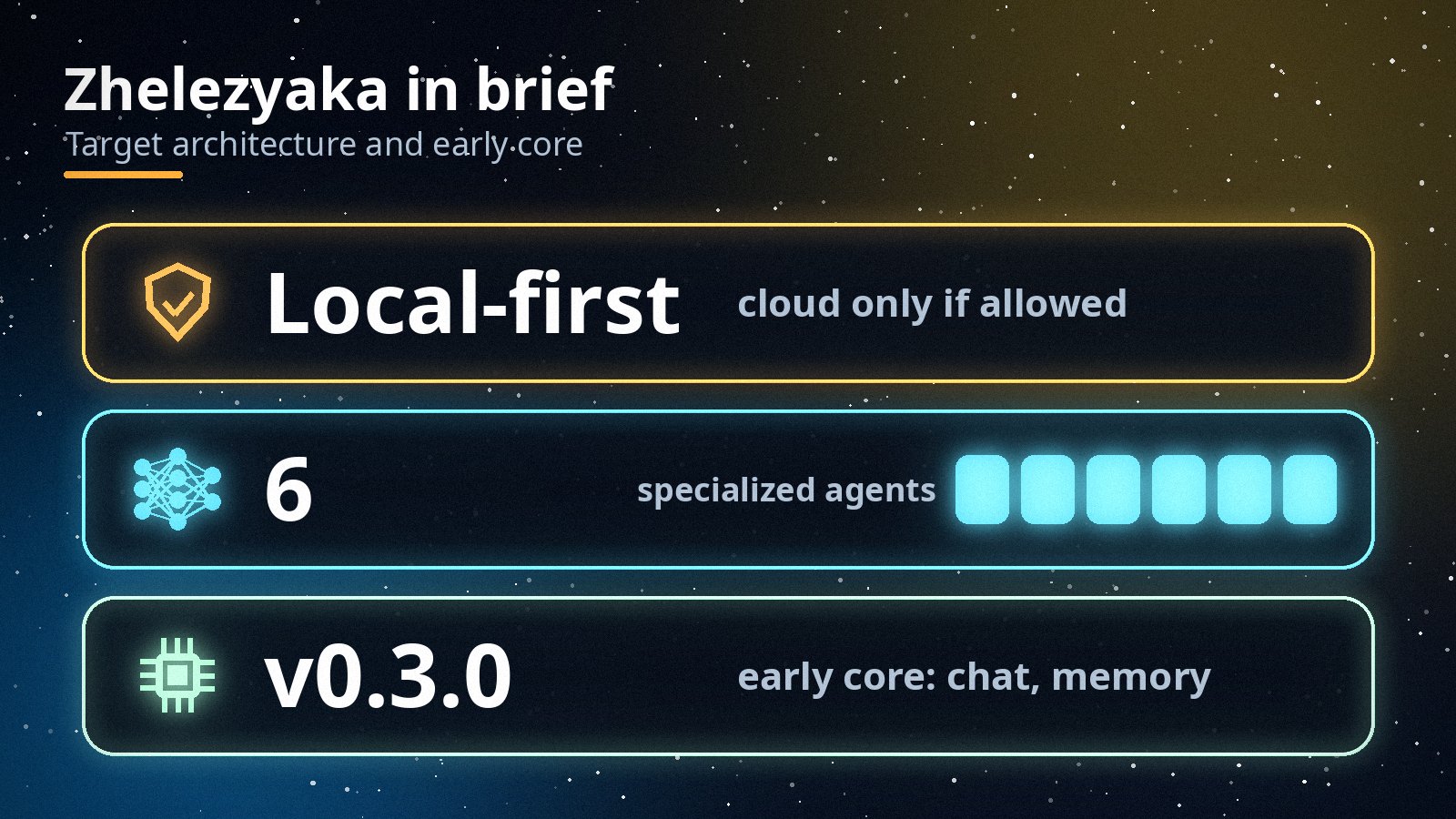
The goal is a system that does not only answer questions but understands context, remembers the history of decisions, uses tools and slowly becomes more useful to its owner. The internet and cloud models can extend it, but the basic work stays available locally. The early version, Zhelezyaka Core v0.3.0, had local chat through Ollama, session history, intent routing and structured memory. Autonomy, a reliable permission system, integrations and specialized agents are the target architecture, not finished features.

  • Category :Personal AI Assistant / Concept
  • Idea :A local, JARVIS-like assistant with memory and character
  • Early core :Core v0.3.0: Ollama chat, sessions, intent routing, memory
  • Target :Voice, agents, tools, permission layer, many devices
  • Mode :Local first, cloud models only when allowed
  • Related :Neuron offline AI
  • Status :Early core built / most of the architecture is a goal

Core Features

What the assistant should be able to do, from the project description. Items beyond the early core are goals.

  • Chat by text and, with permission, by voice. A wake phrase may be enabled but is never required.
  • Tell a direct request from talk with another person or a passing remark like "someday I should do this", and ask when unsure.
  • Remember the user, preferences, corrections and the history of projects.
  • Help with development: code, architecture, tests, documentation, and the reasons behind decisions.
  • Use tools (files, programs, the web, connected services) only within granted permissions.
  • Show initiative, such as suggesting a break or a reminder, with consequential actions behind confirmation.

“Not only answer questions, but understand context, remember why a decision was made, and become more useful over time.”

Design Note - Memory First

Compared With JARVIS

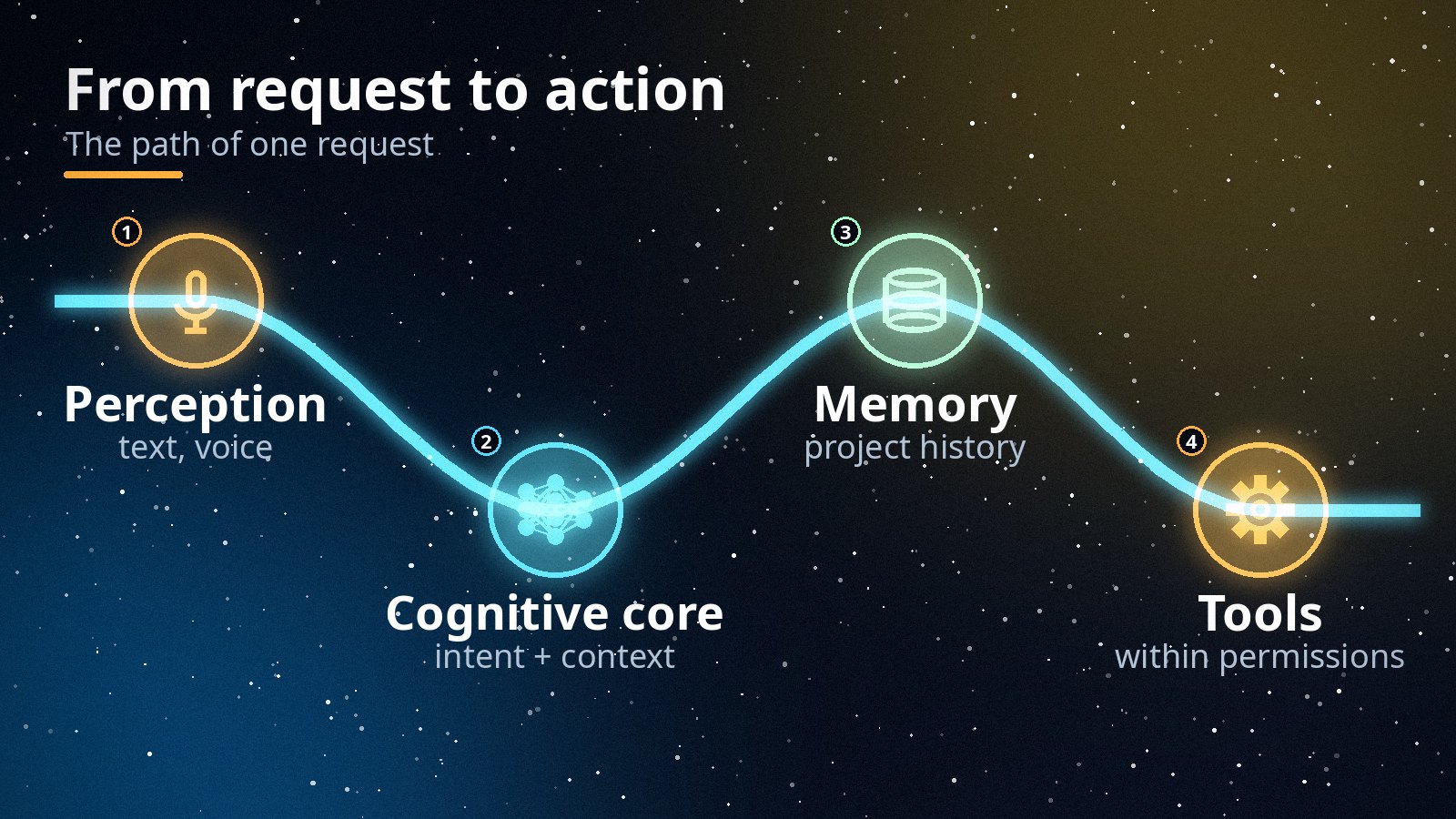
Zhelezyaka shares the general idea of JARVIS from the Marvel films: a personal AI with voice, memory and character. The difference is that JARVIS is fiction, while Zhelezyaka is a real project that can be built gradually. Both follow the same chain: user, perception, AI core, memory, tools, action. Zhelezyaka adds an explicit permission layer so the assistant knows when to act and when to ask first.

AreaZhelezyaka (goal)JARVIS (films)
ConversationText and voice, understands context and intentNatural real-time speech
MemoryUser preferences, projects, decisions, mistakesKnows Tony Stark's habits and a huge history of work
PersonalityOwn character and independent judgementRecognizable humour and initiative
Work with projectsCode, docs, architecture, testsDesigning advanced technology and simulations
DevicesThrough permitted tools and integrationsLab, home, suits, many systems at once
ComputingMostly local models, cloud when allowedFictional, almost unlimited infrastructure
StageEarly core, long road aheadA finished fictional AI

Architecture

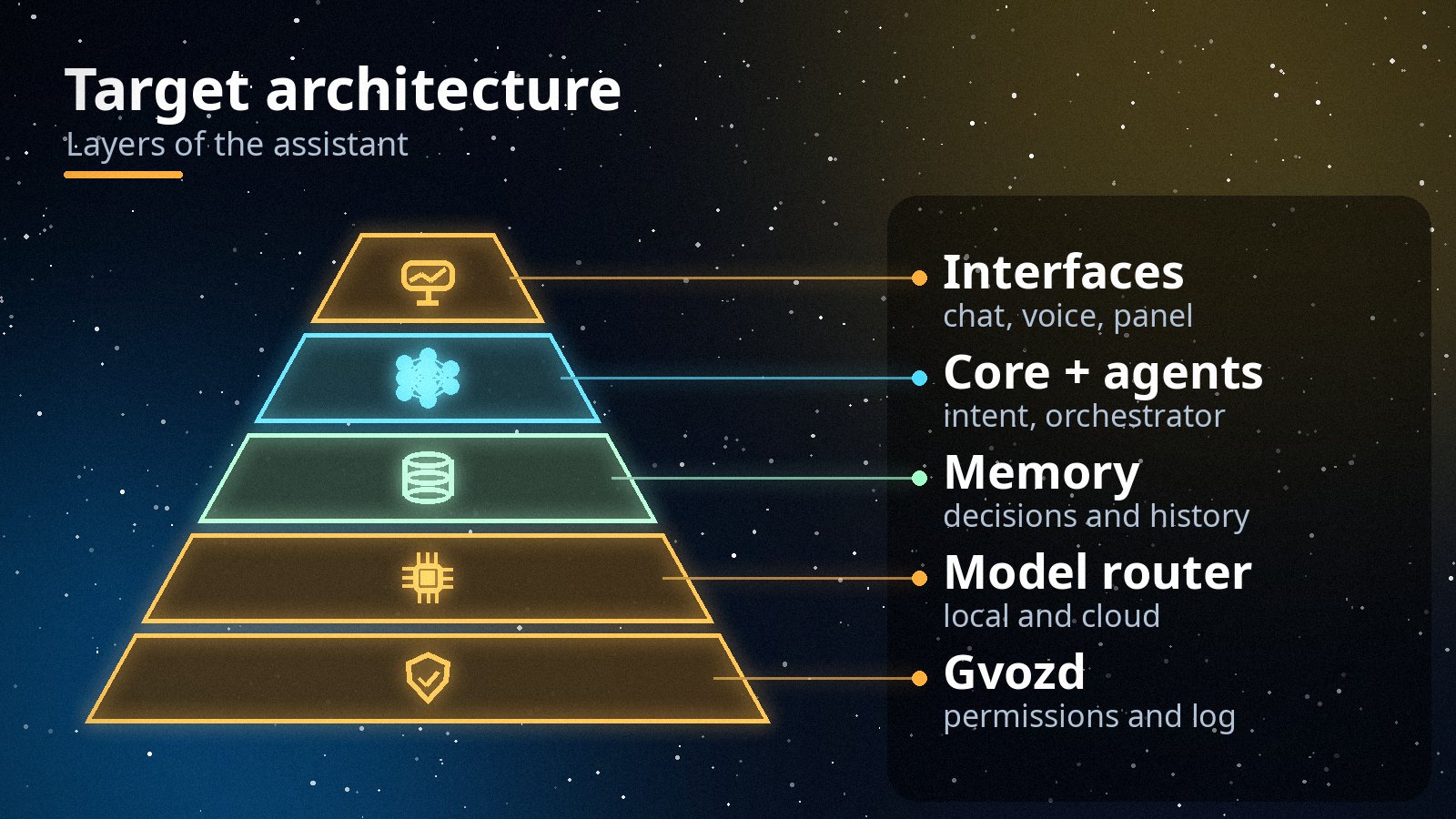
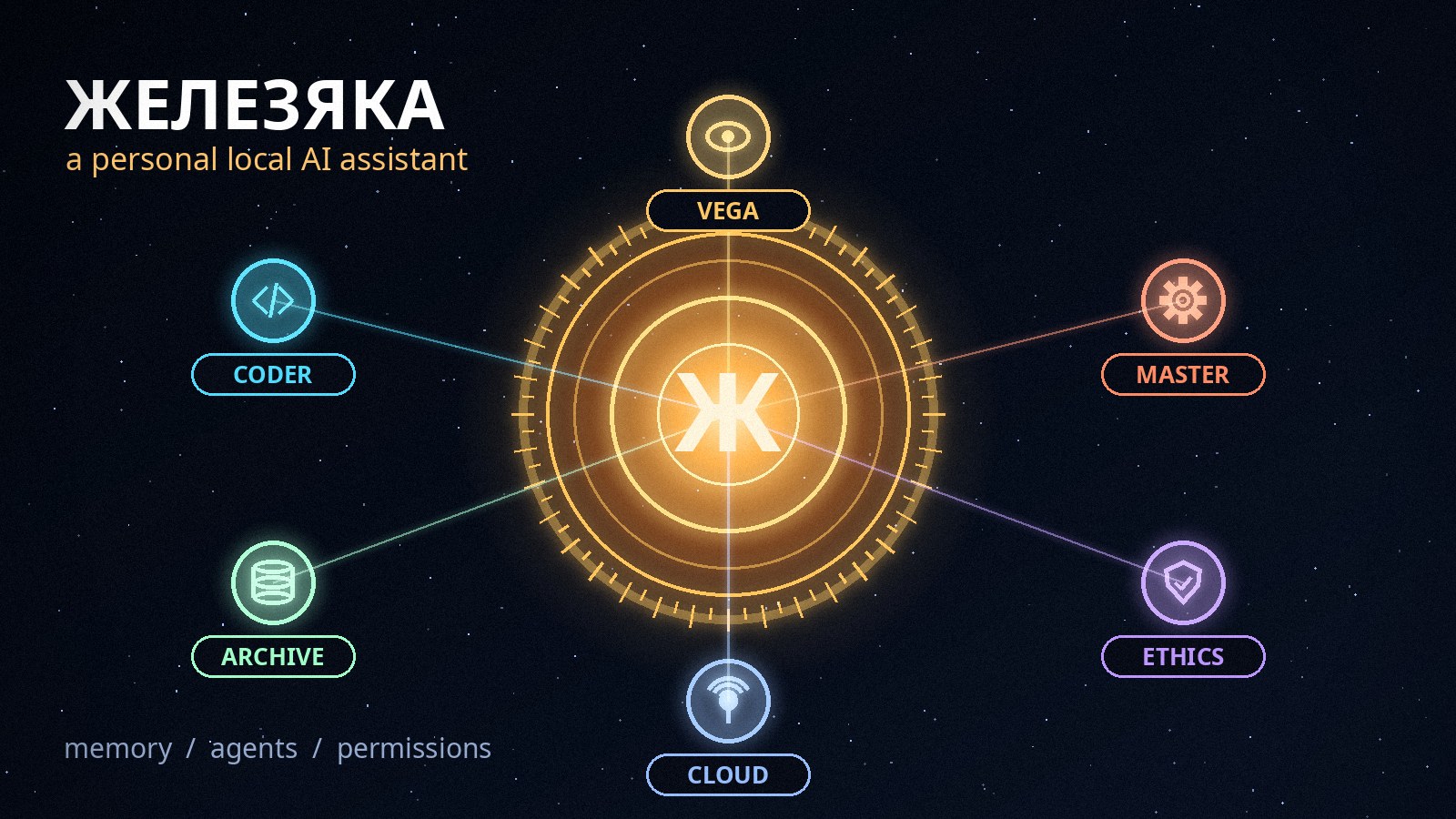
The target architecture has seven parts. Interfaces and perception (chat, voice, panel). A cognitive core that holds personality and rules, reads the intent, pulls the right memory, and picks a model or tool. An orchestrator with specialized agents: Coder, Archive, Vega (analysis and research), Master (system and tools), Ethics and security, and Cloud. A memory of work, not just chat: what was wanted, what options were considered, what was chosen and why, what failed. A model router that chooses between local and external models. "Gvozd" (the Nail), a security layer that decides which tools are available and which actions need confirmation, with an action log. And a gateway to tools and integrations, plus a planner that also watches CPU, GPU and memory so the AI does not get in the way of the computer. The diagrams are conceptual illustrations of this design.

Example Request

  • The user says: "Look at our project and remind me why we chose this architecture".
  • Perception receives the request.
  • The core decides that a project decision must be found.
  • Memory returns the decision, alternatives, test results and reasons.
  • A model turns it into a clear explanation.
  • The interface shows the answer with links to the project records.

What It Shows

  • Product thinking for a personal assistant, with permissions as a first-class idea.
  • A memory design that stores reasoning, not only chat history.
  • Honesty about status: early core versus target architecture.
  • Links to my work on offline AI, voice and recognition.

Related Projects

Automatic Mafia

Automatic Mafia

Python / PySide6 / Face Recognition
Neuron Offline AI

Neuron Offline AI

Offline AI / Memory / Modular Architecture
Sound-to-Action

Sound-to-Action

Python / Audio ML / Local

Project Summary

Send a direct message about this project and it will be delivered to my email.