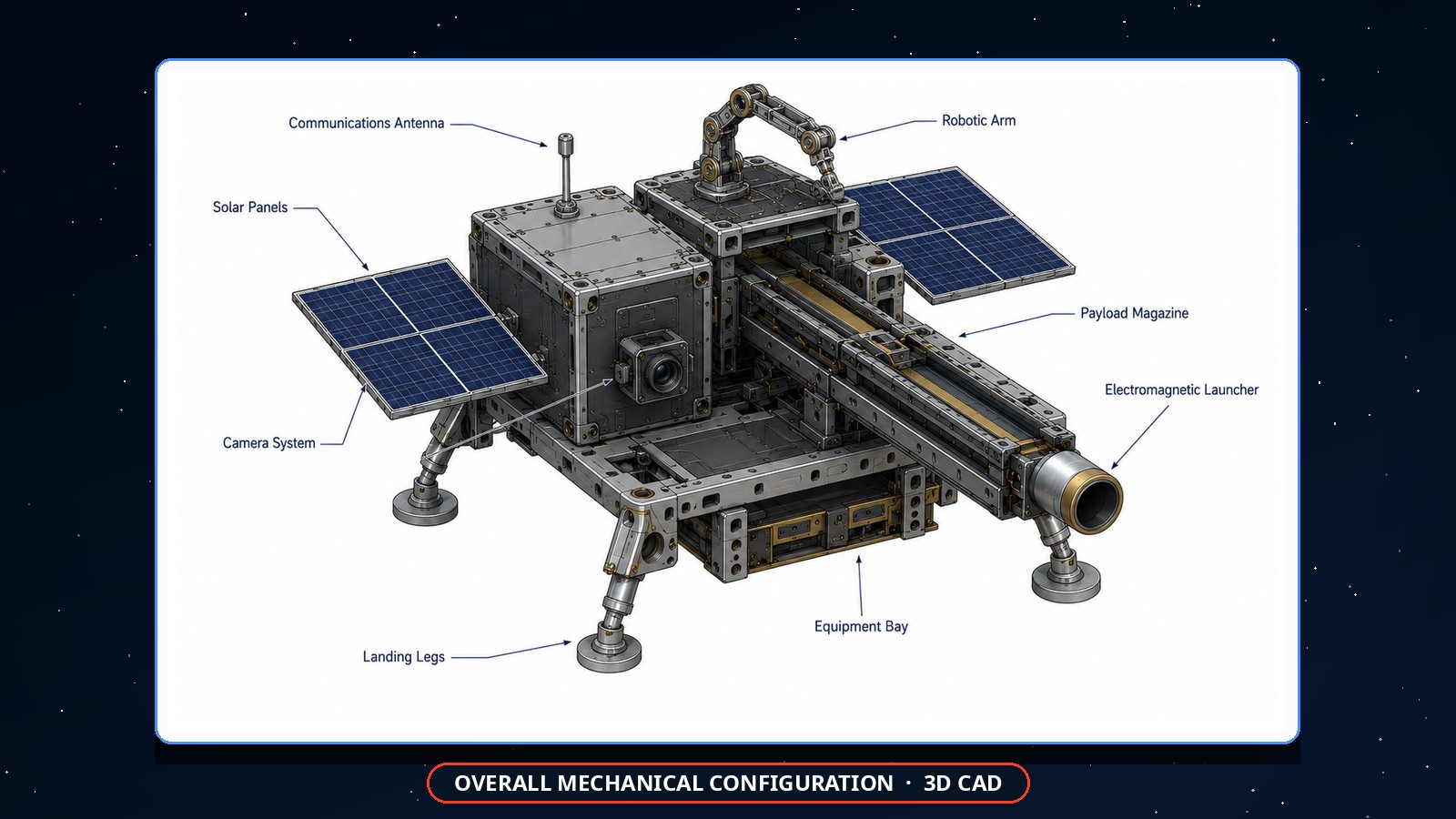
LELP: a reusable electromagnetic launcher for the Moon, and what is hard about it
Every conventional lunar sample-return mission carries a whole chain of hardware: a lander, an ascent vehicle, an orbital transfer stage and an Earth-return capsule. Almost all of it is thrown away after one use. LELP, the Lunar Electromagnetic Logistics Platform, is my concept for turning that around: keep the expensive infrastructure on the Moon for good and send home only a light capsule each time.
The idea
A compact platform lands once. It maps the ground around it, collects rock and regolith with a small robotic arm and scoop, weighs and packages a sample, loads it into a capsule and fires the capsule with an electromagnetic launcher. Between launches it recharges from solar panels into batteries and a supercapacitor bank. The concept study targets a platform of at most 50 × 50 × 40 cm and 10–25 kg, sample capsules from 5 g to 1.2 kg, at least two years of life and at least 100 launches as a goal. Larger versions (LELP-M and LELP-L) would follow if the smallest one works.
Why a coil launcher
An electric launcher needs no chemical propellant on the surface. Energy comes from the sun, and the only thing that is used up is the capsule. The study allows an optional miniature electric propulsion module on the capsule for course correction after launch, not for leaving the Moon.
A back-of-envelope check
This section is my own rough arithmetic, not a result from the study. To leave the Moon a capsule needs about the lunar escape speed, roughly 2.4 km/s.
- Energy. A 100 g capsule at 2.4 km/s carries about 0.28 MJ of kinetic energy, and a 1.2 kg capsule about 3.4 MJ. A power budget of 150 W gives at most about 13 MJ per day (before night, losses and efficiency), so the energy side looks plausible for small payloads.
- Acceleration. This is the hard part. Reaching 2.4 km/s in a 1 m tube means roughly 290 000 g, in 5 m about 58 000 g, and even in 20 m about 14 000 g, all within a few milliseconds.
Loads of that size are very difficult for rock samples, for any electronics and for the launcher structure itself, and they sit uneasily next to the requirement that the launcher must not damage the capsule. The tube length that fits a 50 cm platform is also an open question. I treat the launcher as the main thing that still has to be shown to work.
Open problems
The concept study lists them itself: launcher efficiency and coil optimization, capacitor lifetime under repeated discharge, precise trajectory prediction for unguided capsules, dust in moving mechanisms, thermal management of repeated launches, autonomous fault recovery, how a small capsule is recovered at Earth, and long-term solar panel degradation. The concept is at technology readiness level 2–3: an architecture, not hardware.
What exists today
A technical feasibility study in the format of a concept-phase study (requirements, architecture, trade studies, a verification plan), an MVP concept document, engineering drawings, and a concept website. The calculations volume of the study is still to be written. The documents are independent concept work and not an official NASA, ESA or ECSS publication.
More on the project page and the concept website.